

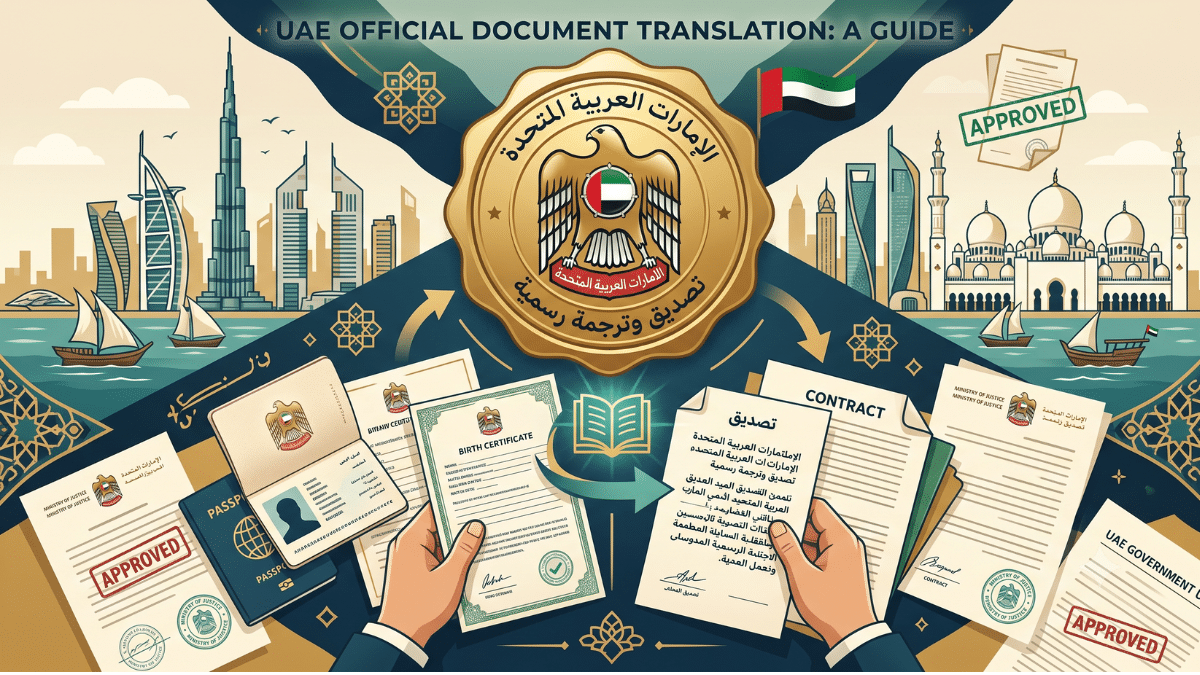
Anyone dealing with UAE government authorities will, at some point, need official document translation UAE services. Whether you’re applying for a visa, enrolling in a university, opening a business, or getting married, foreign-language documents usually need to be translated into Arabic before they are accepted. Getting this step right can save you weeks of delays and repeated rejections.
This guide explains what official document translation UAE involves, when it’s required, and how to avoid common mistakes.
What Is Official Document Translation UAE?
Official document translation in the UAE is the translation of a document into the language required by the receiving authority, in a format accepted for official use. Unlike informal translations, it is generally completed by a licensed legal translator and may require certification or attestation, depending on the document and purpose.
Why Arabic Translation Is Often Required
Arabic is the official language of the UAE and is used by its courts, ministries, and many government authorities. As a result, official documents issued in another language are often required to be translated into Arabic before they can be submitted for legal, immigration, educational, or administrative purposes.
This requirement helps ensure legal clarity, accuracy, and consistency across the country’s administrative and judicial systems. While some authorities may accept English for certain services or communications, many official procedures—particularly those involving courts, government entities, or legal documentation—require an Arabic legal translation completed by a licensed translator accepted by the relevant authority.
Common Documents That Require Translation
Official Document Translation UAE is commonly required for:
- Birth certificates
- Marriage certificates
- Educational certificates and academic transcripts
- Police clearance certificates
- Court documents and legal judgments
- Medical reports
- Commercial documents, such as contracts, company incorporation documents, and trade-related paperwork
- Powers of attorney
- Immigration and visa-related documents
The exact translation requirements vary depending on the government authority, the purpose of the document, and, in some cases, the emirate. Before submitting your documents, it is advisable to check the specific requirements of the relevant authority.
Certified Translation vs. Legal Translation vs. Ordinary Translation
These three terms are often confused, but they are not interchangeable.
Ordinary Translation
An ordinary translation is a general conversion of text from one language to another. It is suitable for personal reference, business communication, or informal use but is generally not accepted for government, court, or legal procedures in the UAE.
Certified Translation
A certified translation is accompanied by a signed statement from the translator or translation provider confirming that the translation is complete and accurate. Whether a certified translation is accepted depends on the requirements of the receiving authority.
Legal Translation
In the UAE, legal translation refers to the translation of official or legal documents by a translator licensed by the UAE Ministry of Justice (or otherwise accepted by the relevant authority). These translations typically include the translator’s official stamp and signature and are commonly required for documents submitted to courts, government entities, and other official institutions.
For legal and official purposes, always check the specific requirements of the authority requesting the document. Submitting a translation that does not meet its requirements may result in delays or rejection.
When Attestation Is Also Needed
Translation and attestation are separate processes, but they often go hand in hand. Documents issued outside the UAE—such as educational certificates, birth certificates, or marriage certificates—may need both attestation and legal translation before they are accepted by certain UAE authorities.
Attestation verifies the authenticity of a document through the appropriate authorities, which may include the issuing country’s authorities, the UAE Embassy or Consulate in that country, and the UAE Ministry of Foreign Affairs (MOFA). The exact requirements and sequence can vary depending on the document type and the authority requesting it. To avoid delays, always confirm whether attestation and legal translation are required before submitting your documents.
Tips for Choosing a Reliable Translation Provider
- Confirm the provider or translator is licensed to produce official document translation UAE authorities will accept.
- Ask whether the translation will include the required stamp, signature, and reference details.
- Check that the provider has experience with your specific document type, such as court documents or educational certificates.
- Confirm turnaround time, especially if you’re working with a submission deadline.
- Ask directly whether the receiving authority (such as a court, ministry, or university) will accept the translation format offered.
Common Mistakes to Avoid
- Assuming any translation service is automatically accepted by every government authority.
- Skipping attestation when it is required for documents issued outside the UAE.
- Submitting translations with missing pages, stamps, signatures, or incomplete information.
- Using a translation of a document that has since been reissued, amended, or updated.
- Not confirming the translation and document requirements with the specific UAE authority before submission.
Frequently Asked Questions
Is English accepted for all UAE government documents?
Not always. While English is widely used in the UAE, many government and legal submissions still require an Arabic translation, particularly for court and official documentation.
Do translated documents expire?
Translations themselves don’t usually have a fixed expiry, but if the original document expires or is reissued, a new translation is generally required. Some authorities also request recently issued translations for time-sensitive processes.
Is attestation different from translation?
Yes. Translation converts the text into another language, while attestation verifies that the document itself is authentic. Depending on the document, both may be required before submission.
Conclusion
Navigating Arabic legal translation and UAE document translation requirements can feel overwhelming, especially for expatriates, students, job seekers, and business owners unfamiliar with local procedures. Understanding the difference between certified, legal, and ordinary translations—and knowing when attestation is also needed—helps you avoid unnecessary delays.
Ultimately, accurate and officially accepted official document translation UAE services are essential for smooth interactions with government authorities, courts, and institutions across the country.