

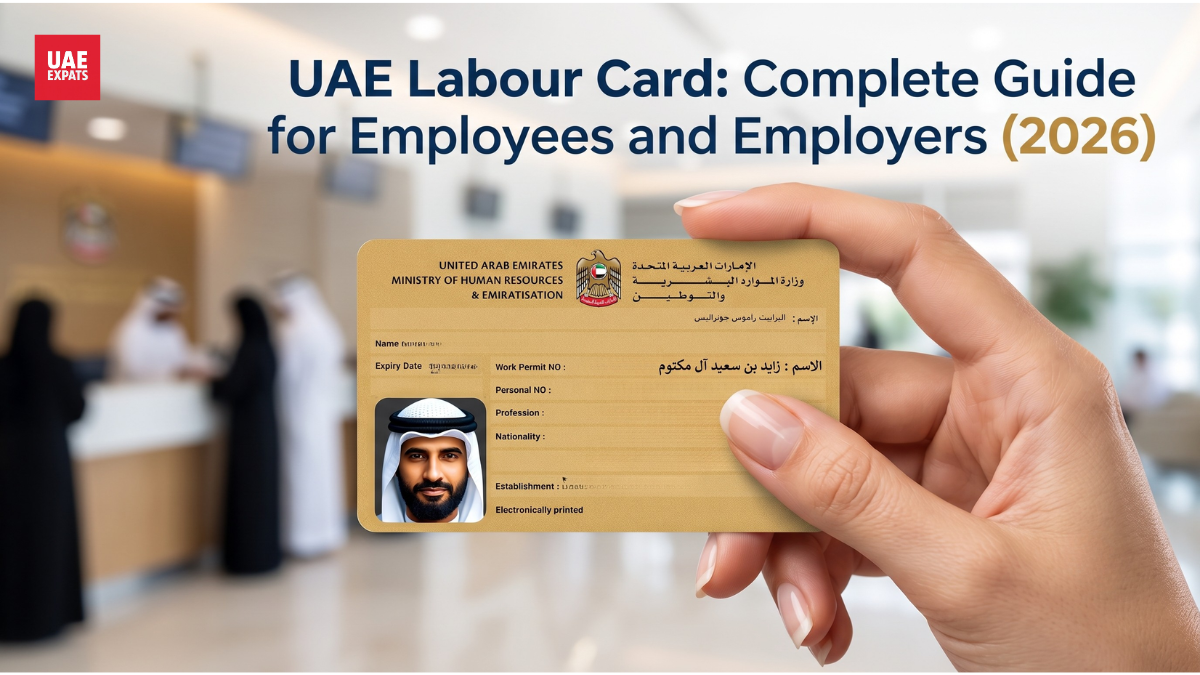
A UAE Labour Card is an official document that confirms you are registered to work for a specific employer in the country. It is linked to your work permit, registered employment contract, and official employment records maintained by the Ministry of Human Resources and Emiratisation (MOHRE). Obtaining the required work authorization and labour card is an essential part of legally working in the UAE. This guide walks employees and employers through the entire process, step by step.
What Is a UAE Labour Card?
A UAE Labour Card is an official employment record that confirms an employee is registered to work for a specific employer in the UAE. It is linked to the employee’s work permit and registered employment contract. For mainland companies, the Labour Card is issued through the Ministry of Human Resources and Emiratisation (MOHRE), while free zone companies issue an equivalent employment identification through their respective authorities. Today, most employees receive a digital Labour Card rather than a physical one, which can be accessed through official government platforms when needed for verification or employment records.
Who Needs a UAE Labour Card?
A UAE Labour Card is required for most people working in the UAE private sector, including:
- Private sector employees working for mainland companies
- New expatriate workers joining a UAE employer for the first time
- Employees changing jobs and joining a new employer
- Existing employees renewing their work permit and employment registration when required
Free zone employees generally go through a similar process, but their employment identification is issued and managed by the relevant free zone authority rather than MOHRE. It is worth checking with the specific free zone for its exact procedures.
UAE Labour Card Eligibility Requirements
Before applying, employees and employers should confirm that the basic eligibility conditions are met.
| Requirement | Details |
| Valid passport | The employee must hold a valid passport, which is used to verify identity and process the work permit, visa, and other employment-related formalities. |
| Job offer | A formal job offer from a UAE-registered employer is required before the work permit application can begin. |
| Work permit application | The employer must apply for a work permit through MOHRE (or the relevant free zone authority) before the employee can legally work. |
| Medical fitness test | Most expatriate employees must pass a medical fitness test as part of the residence visa process. UAE and GCC nationals are generally exempt from this requirement. |
| Emirates ID registration | Expatriate employees must apply for an Emirates ID, which is linked to their employment and residence records. |
| Employment contract | A signed employment contract stating the job title, salary, and terms of employment must be registered as part of the employment process. |
| Residence visa (for expatriates) | After the work permit is approved, eligible expatriate employees must obtain a UAE residence visa to live and work legally in the country. |
Documents Required for a UAE Labour Card
The following documents are commonly requested during the UAE Labour Card application process:
- Passport copy
- Passport-sized photograph
- Entry permit or current residence visa documents, where applicable
- Emirates ID registration details
- Medical fitness certificate, where applicable
- Signed employment contract
- Employer’s trade licence and establishment details, submitted by the employer
- Any other supporting documents requested by MOHRE or the relevant free zone authority
Exact document requirements may vary depending on the employer, the free zone authority involved, the employee’s immigration status, or current government regulations. It is a good idea to confirm the specific checklist with your employer or HR department before starting the application process.
Step-by-Step Process to Get a UAE Labour Card
- Accept the job offer. The employment relationship officially begins once the employee accepts a formal job offer from a UAE employer.
- Employer applies for the work permit. The employer submits a work permit application through MOHRE or the relevant free zone authority.
- Enter the UAE, if applicable. Employees hired from outside the UAE typically enter the country using an entry permit before completing the remaining employment and residence formalities.
- Complete the medical fitness test. Most expatriate employees must undergo a medical fitness test as part of the residence visa process.
- Register for an Emirates ID. Expatriate employees complete Emirates ID registration, which is linked to their residence and employment records.
- Residence visa processing. The employer completes the employee’s residence visa formalities, where applicable.
- Labour Card is issued. Once the required approvals and registrations are completed, MOHRE or the relevant free zone authority issues the employee’s Labour Card or equivalent employment identification.
- Access the digital Labour Card. Employees and employers can view or download the digital Labour Card through the relevant official government platform.
UAE Labour Card Validity and Renewal
A UAE Labour Card is generally valid for the same period as the employee’s work permit and is linked to their employment status. For expatriate employees, it is typically associated with the validity of the residence visa. Before it expires, the employer must renew the required employment authorizations to ensure the employee can continue working legally.
Renewal is generally the employer’s responsibility and typically involves renewing the work permit, updating employment records, and ensuring that the employee’s documents, such as the passport and Emirates ID, remain valid. Employees should keep their personal information and supporting documents up to date to help avoid delays during the renewal process.
Common Reasons for UAE Labour Card Delays
Several factors can slow down the UAE Labour Card application process:
- Missing or incomplete documents
- Incorrect personal or employment information
- Issues identified during the medical fitness test
- Delays in visa processing
- Errors or missing details in employer documentation
Important Things Employees Should Know About Their UAE Labour Card
- Verify your employment contract carefully before signing it.
- Keep copies of all important documents, including your passport, visa, and contract.
- Report any discrepancies in your employment details to your employer as soon as possible.
- Use only official government platforms to check or manage your Labour Card status.
- Ensure your personal details, such as your name and passport number, are accurate across all documents.
UAE Labour Card FAQ
Is a UAE Labour Card mandatory?
Yes. A valid Labour Card, or work permit, is required for legally employed workers in the UAE private sector.
Is the UAE Labour Card different from an Emirates ID?
Yes. The Emirates ID is a general identification document for residents, while the Labour Card specifically confirms employment authorization with a particular employer.
Who pays for the UAE Labour Card?
The employer is generally responsible for handling the application and associated costs for the Labour Card, as it is part of the formal hiring process.
Can I work without a UAE Labour Card?
No. Working without a valid Labour Card or work permit is not compliant with UAE employment regulations.
How can I download my digital UAE Labour Card?
Employees can access and download their digital Labour Card through the official MOHRE platform or the relevant free zone authority’s portal.
What happens to my UAE Labour Card if I change employers?
When changing employers, a new Labour Card process is generally required, as the card is tied to a specific employer and job role.
Conclusion
Getting a UAE Labour Card is an essential step for anyone starting a job in the UAE. It protects both employees and employers by confirming legal employment status. By understanding the eligibility requirements, required documents, and application steps, workers and employers can complete the UAE Labour Card process smoothly and stay compliant with official regulations.